
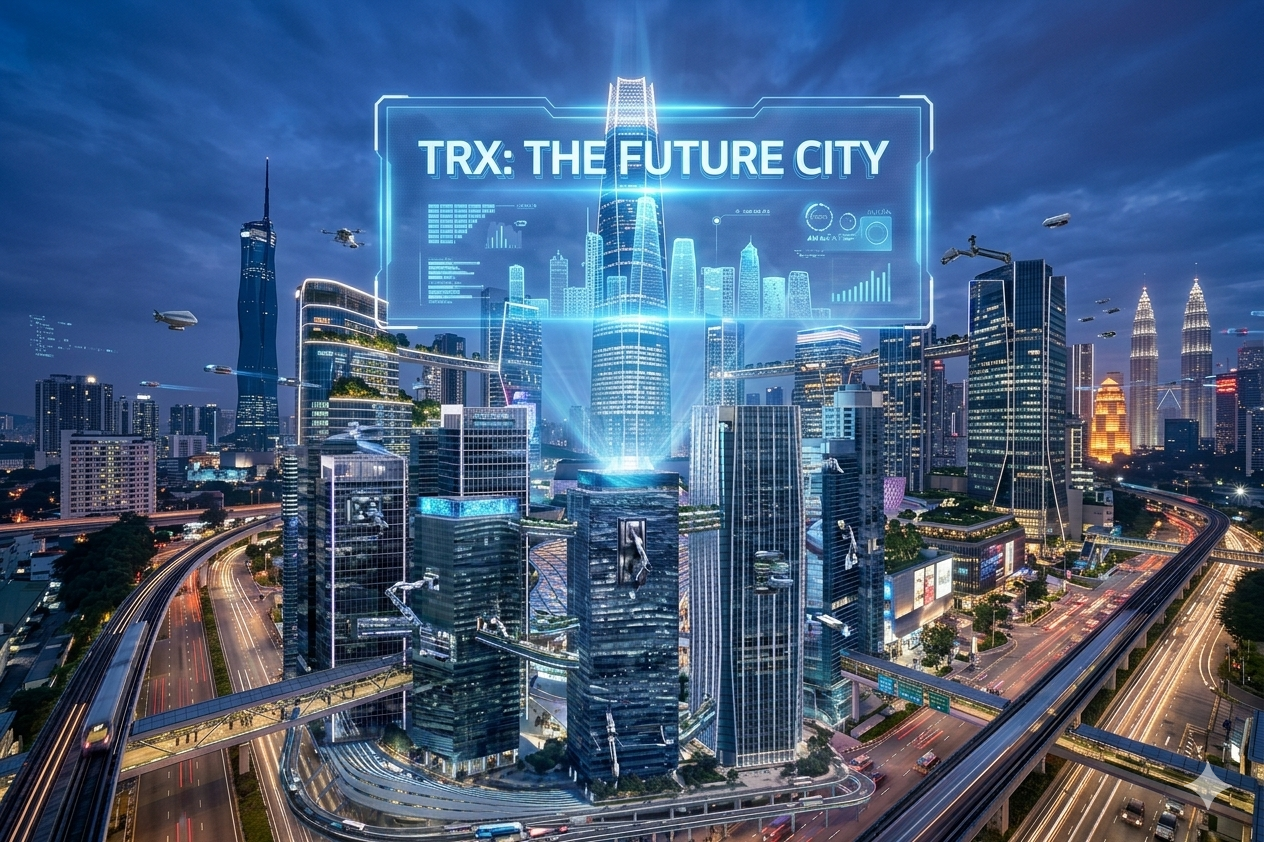
As cities compete harder than ever, one question keeps coming up: what should the city of the future look like?
Malaysia’s Tun Razak Exchange (TRX) is trying to answer it.
It is not just another business district but an international financial centre designed as a “prototype of the future city”. From sustainability and smart-city technology to people-first spaces, every detail points to one core idea: how a city can stay competitive and full of life in the future.
1. TRX’s international ESG certifications
Today we face increasingly serious climate change, and the way global companies operate is changing with it. When choosing where to invest and set up regional headquarters, more and more multinationals (MNCs) no longer look only at cost and location; they set higher and stricter standards for ESG (environmental, social and governance) performance.
That raises a question:
What kind of city and business district can keep attracting international companies and capital in the future?
This is exactly why Tun Razak Exchange (TRX) is drawing international attention.
More importantly, TRX is not just a concept. It has already earned several international ESG certifications and awards:
- Awarded LEED Neighborhood Development Gold pre-certification, meaning its overall urban plan meets international sustainability standards
- One of the first developments in Southeast Asia to hold both LEED Gold and GBI (Green Building Index) Platinum township certification
- The TRX master plan also holds GBI Township Platinum certification, Malaysia’s highest green city standard
Energy-efficient façade

The top of the building uses double-glazed panels with a vacuum layer in between to block external heat. The outer layer also has a UV-resistant coating that cuts heat gain by about 40%, greatly reducing reliance on air-conditioning.
Reducing the urban heat island effect

To reduce the urban heat island effect, The Exchange 106 uses open-grid paving and a range of cooling materials on hard non-roof surfaces, including paving with a high solar reflectance index (SRI), to lower surface temperatures.
Rainwater harvesting

The building collects and reuses rainwater for non-potable uses such as landscape irrigation and toilet flushing, reducing reliance on mains water.
Integrated building management system
The Exchange 106 has a complete building management system (BMS) that monitors and optimises electricity, water and air-conditioning in real time, improving overall efficiency and sustainability.
2. A city within a city: redefining urban living
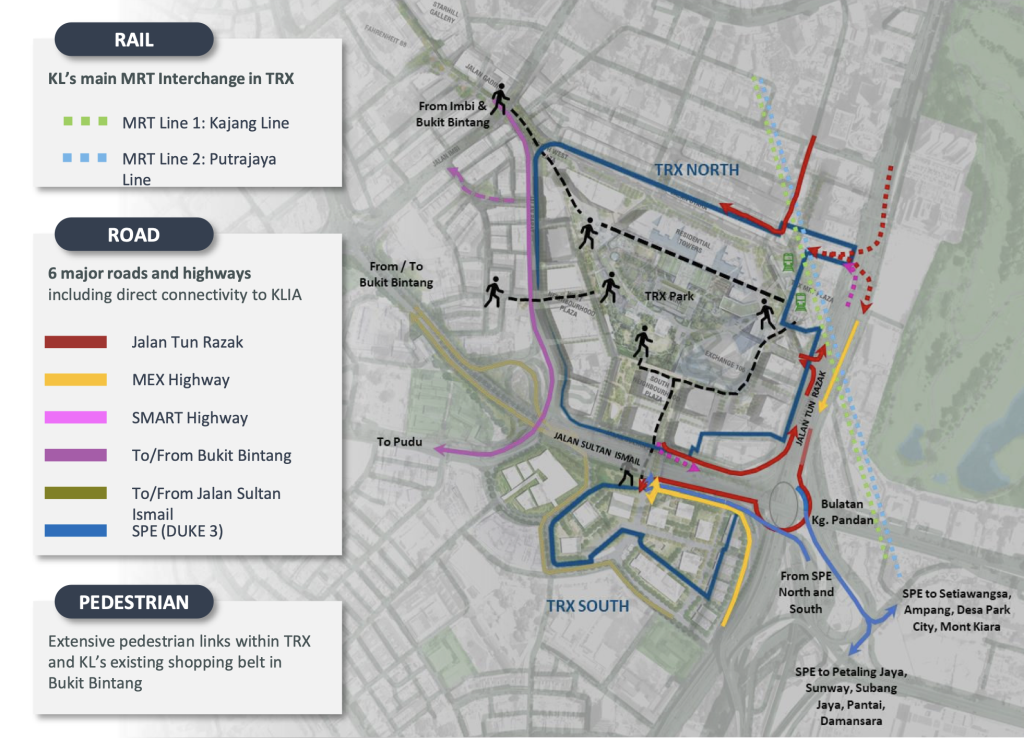
TRX is more than “well connected”: it is planned as one of Kuala Lumpur’s most important transport interchanges. Two MRT lines, the Kajang Line and the Putrajaya Line, meet here at a key interchange station, linking seamlessly to the city’s main business and residential areas, including Bukit Bintang and the hotspots of the city centre.
By road, TRX connects to several major roads and highways, such as Jalan Tun Razak, the MEX Highway and the SMART Highway, with quick access to Kuala Lumpur International Airport (KLIA), greatly improving its international connectivity.
Crucially, TRX also has a complete pedestrian network linked seamlessly to the Bukit Bintang shopping belt, creating a “walkable city”. This multi-layer integration, from underground (MRT) to street level (walking) to elevated roads, makes TRX a true multi-layer connectivity hub and one of the main reasons international companies move in.
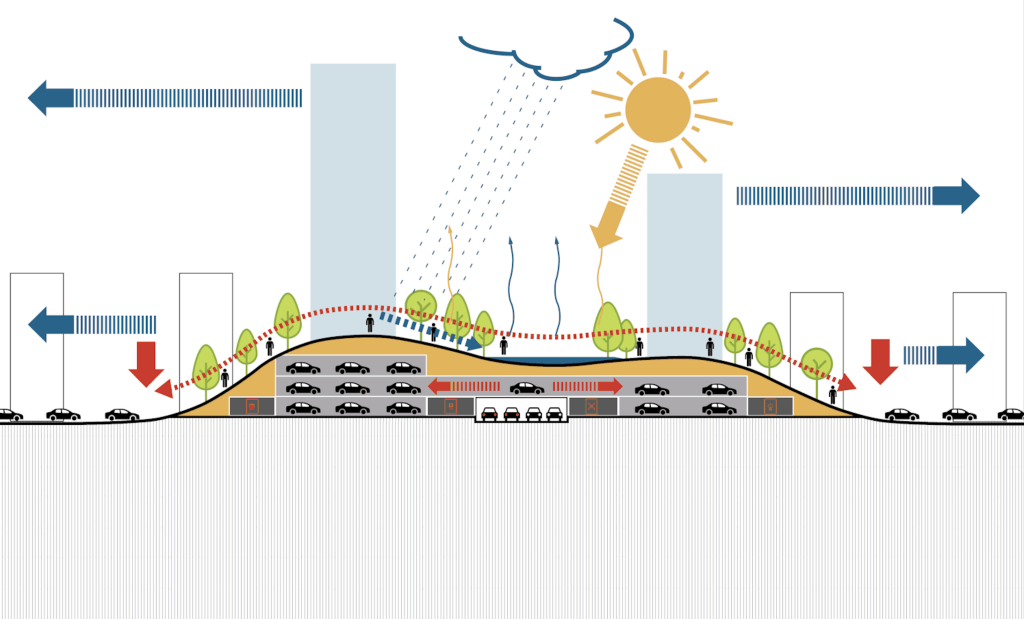
Cars below, people above: TRX creates more liveable city spaces
What makes TRX feel so planned and orderly is its highly integrated, layered design. The whole area follows a “traffic below, people above” concept that clearly separates vehicles from public space: major infrastructure and transport systems are hidden underground or on lower levels, while the levels above become green city parks and walking spaces. This makes the street environment quieter, safer and more pleasant, reduces the heat island effect and improves the overall environment. More importantly, the layered plan combines functions on the same plot, such as public leisure space built on top of infrastructure, so the city achieves multiple uses on limited land. It reflects highly orderly, forward-looking urban planning.
Another major strength of TRX is its “everything in one place” planning, which puts all you need within easy reach. Built around the idea of a “city within a city”, the area combines high-end malls, offices, homes, hotels and public leisure facilities. From daily dining and groceries to luxury retail and business services, everything is within walking distance. This concentrated planning greatly cuts commuting time and reliance on transport, making life more efficient and relaxed. For residents and investors, having everything “downstairs” is not just comfortable; it is an important source of long-term value.
3. How TRX uses technology and policy to become the first choice for international companies
As an international financial centre that Malaysia is prioritising, Tun Razak Exchange (TRX) is not just a large urban development but a future business ecosystem built around the smart city. With highly integrated technology infrastructure and government policy support, TRX is quickly attracting multinationals (MNCs) to set up regional headquarters and operations here, strengthening its position as a Southeast Asian business hub.
For offices, TRX has advanced digital infrastructure, including full-fibre networks and scalable data systems that ensure fast, stable global connectivity. An integrated management system (TIMS) centralises traffic, security and building operations for real-time monitoring and efficient decisions. Using the Internet of Things (IoT), artificial intelligence (AI) and automation, TRX creates energy-efficient, ESG-compliant offices that help companies lower operating costs and improve sustainability.
On policy and incentives, TRX benefits from Malaysia’s digital and investment incentives. Eligible companies can apply for Malaysia Digital status (formerly MSC), with corporate tax relief and digital industry benefits. Companies can also apply through the Malaysian Investment Development Authority (MIDA) for Pioneer Status or Investment Tax Allowance (ITA), easing the pressure of initial investment. The government also offers fast-track work visas for foreign professionals and talent programmes, helping companies quickly build core teams and regional operations.
TRX has already attracted many international companies and financial institutions, including HSBC, Prudential, Affin Bank and Huawei, and professional services firms such as PwC have confirmed they will move their headquarters to TRX, further strengthening its position as an international financial centre.
Overall, TRX offers not just high-tech offices but a combination of strong incentives and a full business ecosystem, a complete “technology + policy + talent” advantage. That makes it not just a business landmark but a strategic base for multinationals expanding into Southeast Asia.
Summary
In an international financial core like Tun Razak Exchange (TRX), offices and large malls are mainly owned by big companies and institutions. For individual investors, the real opportunity to take part is in the residential market.
The KLCC area in central Kuala Lumpur is already very mature, with few new plans left to lift prices. TRX, by contrast, is at an early stage of growth. As company offices move in and footfall and economic activity rise, that is often exactly when property values start to climb.
Institutions such as Monash University Malaysia and PwC have signed up to move in but are not yet fully operational, which means the area’s potential is not yet fully reflected in prices. That makes now a prime time for investors to position themselves early.
We have shortlisted promising residential projects around TRX, such as Golden Crown, to help you catch this wave of growth. For the bigger picture, read our introduction to Tun Razak Exchange.
Message us for more details and a tailored investment analysis.