
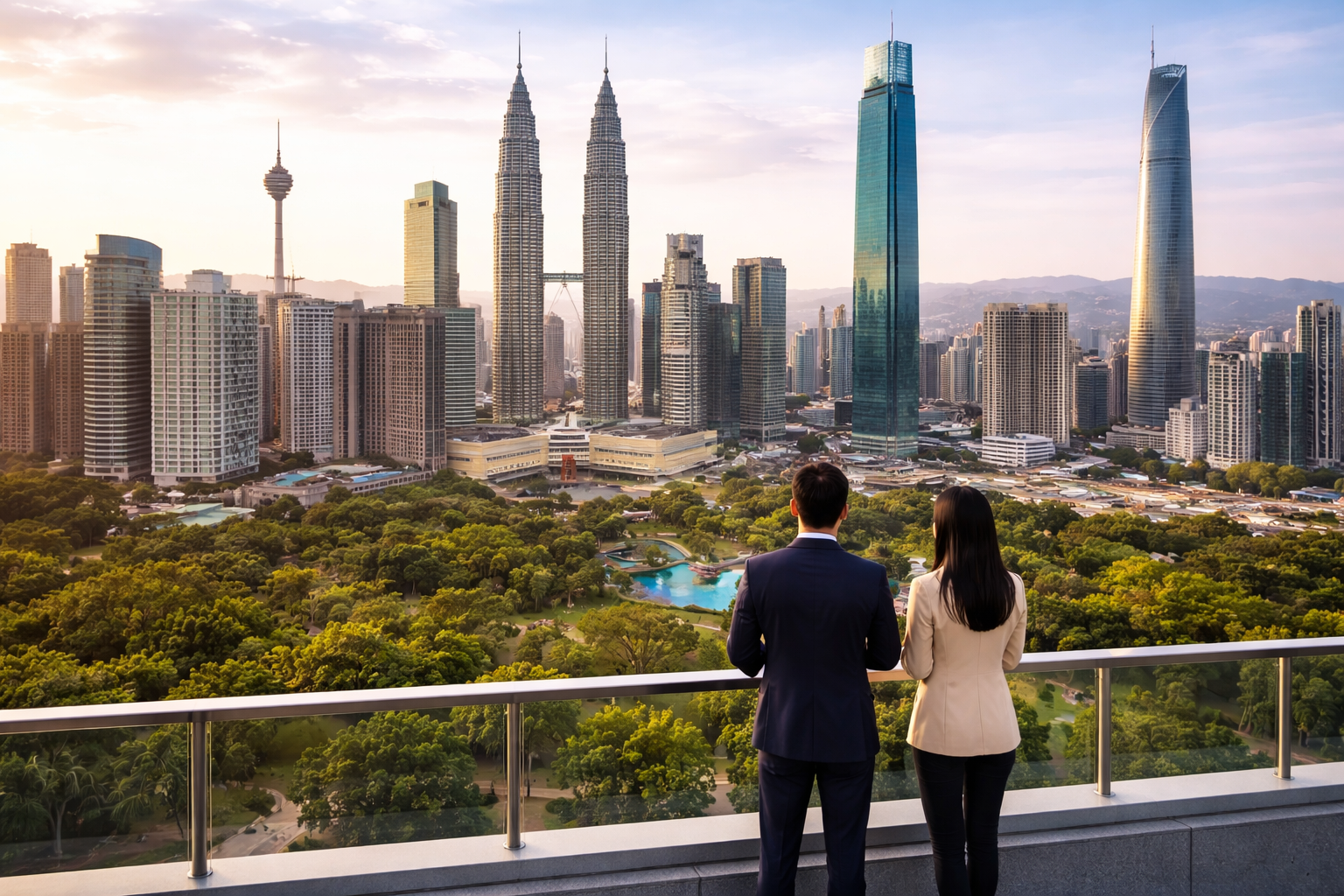
As conflict reshapes the Middle East and Gulf cities become targets for the first time, a wave of professionals, retirees and families is exploring Malaysia’s MM2H programme as a route to residence, security and property investment. Here is what international investors need to know.
The 2026 Iran war turned Gulf capitals into conflict zones for the first time, triggering capital flight. With its geopolitical neutrality, Muslim-majority population and world-class Islamic finance ecosystem, Malaysia has become a popular destination. Its MM2H residence programme, which now requires a property purchase, has become a channel linking foreign capital to Malaysian property. Enquiries from Saudi Arabia, the UAE, Kuwait, Bahrain and Qatar are already rising.
Why Malaysia is a safe haven for property investment in 2026
- The Middle East crisis and the rise of MM2H: how conflict moves capital
- Neutral ground: why Malaysia is ideal for MM2H applicants
- Why Malaysia? Six reasons it stands out
- From MM2H visa to property keys: turning residence into investment
- The investment case
- Connecting capital and property
- FAQs
The Middle East crisis and the rise of MM2H: how conflict moves capital
When geopolitical tension escalates, capital moves. On 28 February 2026, joint US–Israeli air strikes on Iran triggered a full regional war. Iran retaliated with missiles and drones against Israel, US bases and Gulf allies. Gulf capitals came under direct attack for the first time.
Residential areas in Manama, Bahrain, Abu Dhabi airport, and oil fields in Saudi Arabia and Kuwait were hit, and even Qatar and Oman were attacked.
The economic fallout was just as damaging. Oil prices surged to USD 120 a barrel. Qatar and Kuwait declared force majeure on energy contracts. The Strait of Hormuz, which carries about 20% of the world’s oil, was effectively shut.
The UN Security Council passed Resolution 2817 condemning the attacks and demanding they stop.
The pattern is familiar. After the war in Ukraine, Russian capital moved to Dubai and Southeast Asia. When their home market slowed, Chinese investors diversified into Australia and Malaysia.
Now capital from the Gulf is showing the same dynamic, as more professionals, retirees and families ask themselves:
Where is safest right now?
For many, the answer is Malaysia.
Neutral ground: why Malaysia is ideal for MM2H applicants
Malaysia is increasingly seen as geopolitically neutral, and that view is now turning into real enquiries. Anthony Liew, president of the Malaysia MM2H Consultants Association, confirmed in a report published by The Star on 16 March 2026 that enquiries from Gulf states are rising, coming from Saudi Arabia, the UAE, Kuwait, Bahrain and Qatar.
Industry insight

According to Liew, potential applicants are mainly professionals, retirees and parents seeking education opportunities for their children. Applications have not yet surged, as potential applicants are still verifying documents, but the trend is clear and enquiries are growing steadily.

Kashif Ansari, co-founder and group CEO of Juwai IQI, confirmed the shift. He said Malaysia is a natural destination for people from the Middle East because it is a safe haven far from the conflict. He noted that Middle Eastern buyers are already turning to Malaysia, and that outside the Middle East very few multilingual markets offer both halal food and Islamic finance.

In the same Star report, Sunway University economics professor Dr Yeah Kim Leng noted that Malaysia has long had a small but growing Middle Eastern expatriate community. He said this gives Malaysia a relative advantage in attracting this group, especially if regional turmoil continues.
Source: The Star, More Middle East interest in MM2H
Why Malaysia? Six reasons it stands out
Malaysia’s appeal does not come from a single factor but from a combination of strengths. For Gulf citizens in particular, these reasons make Malaysia stand out:
- Geopolitical neutrality
Malaysia hosts no foreign military bases and has remained diplomatically neutral in the US–Iran and Israel–Palestine conflicts. For Gulf citizens who became targets because of their proximity to US military facilities, this is not a theoretical benefit but a direct safety guarantee. - A Muslim-majority country with cultural affinity
Malaysia is one of the few economically developed, politically stable countries where Gulf citizens can find a truly familiar environment. Halal food is everywhere, Islamic schools run alongside international curricula, and daily life reflects Islamic values. That makes relocating far smoother than moving to a Western country. - World-class Islamic finance infrastructure
Malaysia is a global centre for Islamic banking, takaful (Islamic insurance) and Islamic real estate investment trusts (REITs). Gulf investors can structure property purchases, mortgages and savings entirely within a Shariah-compliant framework, something very few relocation destinations can offer. The global Shariah-compliant property market is worth about USD 12.5 billion, and Malaysia ranks second only to Saudi Arabia in fund assets. This existing infrastructure puts Malaysia in a uniquely strong position to absorb capital from the Gulf. - Competitive prices and healthy yields
Prime Kuala Lumpur property costs about EUR 3,000–5,000 per square metre, with rental yields of 4.5%–6%. Compared with Dubai or Singapore, Malaysia offers significantly more value per dollar. The ringgit remains favourable against the US dollar and Gulf currencies, giving foreign buyers entering now extra purchasing power. - An established Middle Eastern expatriate community
According to The Star, Malaysia already has a small but growing Middle Eastern expatriate community. It gives newcomers a social and cultural foundation, from Arabic-speaking communities to established business networks, a practical advantage that competitors such as Thailand and Singapore do not yet offer on the same scale. - Government support and Visit Malaysia 2026
The Ministry of Tourism, Arts and Culture has named the Middle East a priority tourism market for 2026. The MM2H programme alone has contributed RM3.87 billion (about USD 870 million) to the national economy, and the government is actively promoting the country to Gulf audiences through Visit Malaysia 2026.
From MM2H visa to property keys: turning residence into investment
The Malaysia My Second Home programme (MM2H) is the route that turns interest in Malaysia into actual property investment. It is the mechanism that links residence with property, and it increasingly fits the needs of Gulf investors.
What is MM2H?
MM2H is a government-backed long-term residence programme that gives foreign nationals a renewable social visit pass of 5 to 20 years. Launched in 2002 and significantly reformed over the past two years, it now runs on a clear tiered framework with four categories: Platinum, Gold, Silver and Special Economic Zone (SEZ). See our comparison of the four MM2H tiers.
Key benefits include:
- Tax exemption on foreign income remitted to Malaysia;
- Tax-free interest on the compulsory fixed deposit;
- Family members can be included (spouse, children under 34, dependent parents);
- Multiple-entry travel and access to Malaysia’s healthcare and education systems. All applications go through a licensed MM2H agent and are processed by the one-stop centre of the Ministry of Tourism, Arts and Culture (MOTAC).
- Applicants need comprehensive medical insurance with cover of at least RM80,000 and must pass a medical check.
| Tier | Visa length | Fixed deposit | Property required |
|---|---|---|---|
| Platinum | 20 years | Highest threshold | Yes (mandatory) |
| Gold | 15 years | Medium threshold | Yes (mandatory) |
| Silver | 5 years | Lowest mainland threshold | Yes (mandatory) |
| SEZ / SFZ | 5 years | Lowest overall threshold | Designated zones only |
MM2H explained: why Malaysia is a safe haven for property investment in 2026
As the Middle East changes and Gulf investors look to move capital, Malaysia’s MM2H programme has become a magnet for foreign capital and families. It offers more than residence for retirees; it is especially attractive to Gulf citizens interested in property investment.
The key link: why a property purchase is required
The current MM2H framework requires participants in all mainland tiers to buy property. This turns the programme into a combined residence and investment channel, making MM2H especially attractive to foreigners with investment goals, not just retirement or lifestyle migrants.
How it works:
Each state sets its own minimum property price. In Kuala Lumpur, the minimum for foreign buyers is RM1 million (about USD 225,000), and in prime areas of Selangor it can reach RM2 million. States such as Penang, Johor and Melaka offer lower entry points. The property must be bought within about a year of visa approval and held for at least 10 years.
The role of the compulsory deposit:
MM2H participants can use up to 50% of the compulsory fixed deposit for buying a home, education or medical costs. This creates a direct financial mechanism linking the programme’s residence requirement with property investment.
The Islamic finance angle
For investors from Gulf states, Islamic finance products are essential. Malaysian banks offer Shariah-compliant home financing, including Murabaha and Diminishing Musharakah structures that fully follow Shariah principles. This means Gulf citizens can use familiar financial tools to buy property without compromising their financial values.
The investment case
For Gulf investors, Malaysia’s economic indicators and property returns are very attractive. Malaysia’s GDP growth is forecast to stay between 4.0% and 4.5% in 2026, with inflation between 1.3% and 2.0%. The policy rate has stayed at 2.75% since May 2023, putting effective mortgage rates at about 3.95%–4.50%. Together with rental yields of 4.5%–6% in prime Kuala Lumpur, these figures offer investors a stable, income-producing environment.
What investors should watch
- Stamp duty for foreign buyers
Malaysia’s 2026 Budget introduced stamp duty of 4% to 8% on residential property bought by foreigners. It raises upfront costs, but it also signals the government’s preference for genuine long-term investment over speculation, which ultimately helps protect asset values. See taxes and fees for foreigners. - Processing time
MM2H applications usually take 2 to 3 months, and all applications must go through an authorised agent. For applicants from Gulf states, document verification may take longer because of current disruption to government services in the region. - Global competition
Economist Geoffrey Williams warns that in the short term MM2H may look less competitive than some other global visa programmes, but he believes that in the long run Malaysia will remain attractive to people from conflict zones. - State differences
Minimum prices, foreign ownership rules and available housing stock vary widely between states. Kuala Lumpur and Penang have the most established expatriate communities, while Johor offers the most attractive entry prices, especially through the Forest City SEZ route. Working with an experienced local consultant is essential to match your budget and lifestyle.
Summary
The three core arguments are:
- Conflict moves capital: the 2026 Iran war shattered the Gulf’s image as an isolated safe haven, and citizens of Saudi Arabia, the UAE, Kuwait, Bahrain and Qatar are actively looking to move capital and secure a second residence in a stable country.
- Malaysia can absorb that capital: its geopolitical neutrality, cultural and religious affinity, world-class Islamic finance infrastructure and competitive cost of living are unmatched by other destinations in the region.
- MM2H turns residence into investment: the mandatory property purchase creates a direct pipeline from foreign residence applications into the Malaysian property market, benefiting both investors and the national economy.
FAQs
1. What is MM2H and who can apply?
MM2H is a Malaysian government-backed long-term residence programme that lets foreign nationals live in Malaysia on a renewable 5 to 20-year visa. It is open to retirees, professionals, investors and families looking for a stable second home.
2. Can citizens of Gulf states (Saudi Arabia, the UAE, Kuwait, Bahrain, Qatar) apply?
Yes. MM2H is open to citizens of every country with diplomatic relations with Malaysia, with no restrictions based on nationality, religion or race.
3. Is a property purchase mandatory?
Yes. Under the 2026 framework, participants in all mainland MM2H tiers (Platinum, Gold, Silver and SEZ) must buy a qualifying property within about a year of visa approval and hold it for at least 10 years.
4. What is the minimum property price for MM2H participants?
It depends on the state. In Kuala Lumpur, the minimum for foreign buyers is RM1 million (about USD 225,000). In prime areas of Selangor it can reach RM2 million. Johor, Penang and Melaka have lower entry points.
5. Is Islamic financing available?
Yes. Malaysia is one of the world’s leading Islamic finance centres, and local banks offer Shariah-compliant home financing, letting Gulf investors buy property within a familiar framework.
6. Is foreign income taxed?
No. Foreign income remitted to Malaysia by MM2H holders is not taxed, and interest on the compulsory fixed deposit is also tax-free.
7. Do I need to live in Malaysia full time?
Participants under 50 must spend at least 90 days a year in Malaysia, and these days can be shared with dependants. Participants aged 50 and above have no minimum stay requirement.
To find out how MM2H could work for you, see the full MM2H requirements or contact our consultants.